


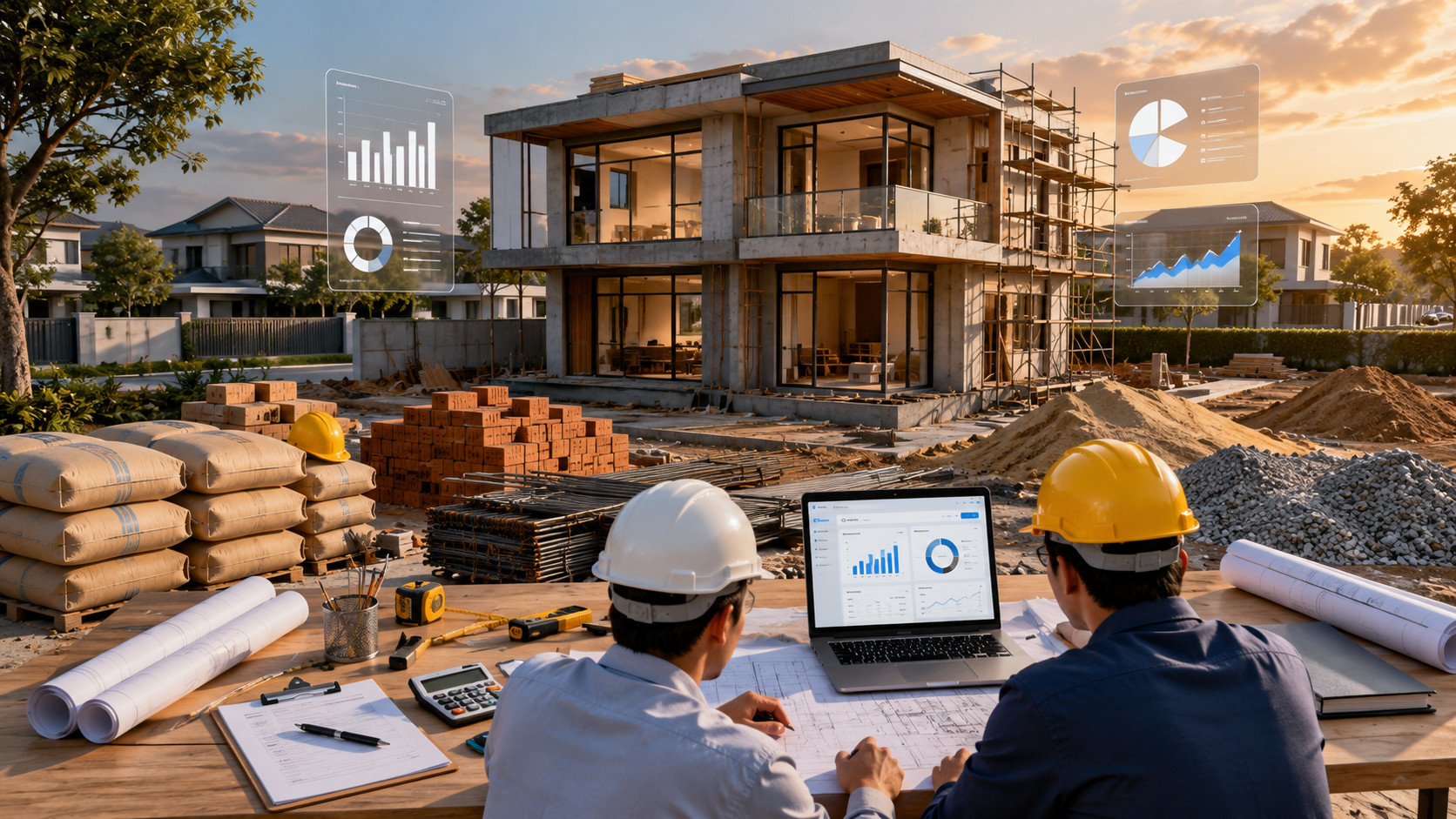
Estimate your House Construction Cost Calculator. Get accurate material, labour, RCC, flooring, and finishing cost per square foot instantly.
House Construction Cost Calculator
Building your dream home is one of the biggest financial commitments you’ll ever make. Whether you’re planning a compact single-floor residence or a spacious multi-storey villa, understanding the complete construction budget before breaking ground can save you from unexpected expenses and project delays.
A House construction cost calculator is one of the most valuable planning tools available for homeowners, architects, engineers, contractors, and property investors. Instead of relying on rough estimates or outdated pricing, a modern Construction cost estimation tool provides a data-driven estimate based on your project’s specifications, helping you make informed financial decisions from day one.
Today’s construction projects involve much more than simply multiplying the total area by a standard rate. Every project has unique variables that directly influence the Total estimated construction cost, including the Built-up area, location, construction quality, structural design, labour availability, and the ever-changing prices of building materials. That’s why a reliable Home building cost estimator considers dozens of factors before generating an estimate.
One of the first questions homeowners ask is, “What will be my Construction cost per square foot?” While this is a useful starting point, the answer varies depending on your city, the type of foundation, the structural system, the finishing materials you choose, and whether you’re building a budget-friendly home or a luxury residence.
For example, constructing a home in a metropolitan city usually costs more because of higher Location-based construction rates, increased transportation expenses, and higher Labour rate per sq ft. Similarly, choosing premium finishes or smart home features significantly affects the overall budget compared to a standard residential build.
Another important factor is the type of structure. Most modern homes use a Reinforced Cement Concrete (RCC) or RCC frame structure, which offers better durability, flexibility, and earthquake resistance. In contrast, smaller homes in certain regions may still use a Load-bearing structure, which can reduce costs for specific project types but may not be suitable for larger buildings.
A comprehensive construction calculator goes far beyond giving a single number. It performs Material cost estimation, Labour cost estimation, and even generates a detailed Cost breakdown by construction phase. This enables homeowners to understand how much money is allocated to each stage of construction, from excavation and foundation work to painting and final finishing.
Material planning is another area where these calculators prove invaluable. They estimate quantities for essential resources through Cement quantity calculation, Steel quantity calculation, Brick quantity estimation, Sand quantity estimation, and Aggregate quantity calculation. Knowing these quantities early helps reduce waste, improve procurement planning, and negotiate better prices with suppliers.
An accurate estimate also supports effective Construction budget planning, ensuring you have sufficient funds available throughout the project lifecycle. Rather than facing unexpected cash flow issues midway through construction, you can schedule expenditures according to the Cost by construction stage, making the process more manageable and financially secure.
Modern calculators also allow users to compare different Construction quality selection options. Whether you choose Construction quality (Basic / Standard / Premium / Luxury), the calculator adjusts both material specifications and labour costs accordingly. This flexibility makes it easier to balance quality with budget.
Another major advantage is location customization. Since prices vary widely across regions, advanced calculators use City-wise construction cost, State-wise construction cost, and even Pincode-based cost estimation to provide localized pricing rather than generic national averages.
Additionally, homeowners can customize their projects using House type selection, specify the number of floors through Floor-wise cost estimation, and adjust inputs based on architectural preferences. This level of personalization significantly improves Construction cost accuracy, making the estimates far more practical than manual calculations.
Construction is not only about costs but also about efficient planning. A good calculator supports Construction timeline estimation, helping homeowners understand when major expenditures will occur and how to allocate funds across different milestones.
Whether you’re constructing your first home, expanding an existing property, or investing in residential real estate, using a professional Construction material calculator simplifies planning, improves transparency, and minimizes costly mistakes.
In this comprehensive guide, you’ll learn how construction cost calculators work, which factors influence residential building expenses, how building materials are estimated, and practical ways to optimize your budget without compromising quality. By the end, you’ll have a clear understanding of how to estimate your project’s cost with confidence and plan every stage of construction more effectively.
What Is a House Construction Cost Calculator?
Planning a house without estimating its cost is similar to starting a road trip without knowing the distance or fuel required. A House construction cost calculator removes the guesswork by providing a systematic estimate of the overall investment needed to complete a residential project.
Rather than offering a simple average, a professional calculator analyzes multiple project variables simultaneously. It evaluates the Built-up area, construction specifications, regional pricing, labour expenses, and material quantities to generate a reliable estimate that reflects current market conditions.
In simple terms, a construction calculator acts as a digital planning assistant. Instead of manually calculating hundreds of line items, it performs thousands of calculations in seconds to estimate the Residential building cost accurately.
Most modern calculators begin with the project’s total area. Users enter the Built-up area, choose their preferred Construction quality selection, specify the number of floors, and identify the project location. From there, the calculator applies localized pricing using Location-based construction rates, City-wise construction cost, State-wise construction cost, or Pincode-based cost estimation.
The result is much more than a single figure. A comprehensive estimate includes:
- Overall project budget
- Material cost estimation
- Labour cost estimation
- Material quantities
- Construction phase costs
- Expected project duration
- Resource planning
- Downloadable Construction cost report (PDF)
These reports help homeowners discuss budgets with architects, engineers, contractors, and financial institutions before construction begins.
Many advanced calculators also include a Construction area calculator, allowing users to compare different floor plans or modify project dimensions instantly. This makes it easier to evaluate design alternatives before finalizing architectural drawings.
Another valuable feature is the Material quantity estimator, which predicts the amount of cement, steel, bricks, sand, and aggregates required for the project. This improves purchasing decisions and reduces unnecessary material wastage.
Instead of relying solely on contractor quotations, homeowners gain an independent estimate that improves negotiation and budget transparency.
How Does a Construction Cost Calculator Work?
Although the output appears simple, a modern Construction cost estimation tool performs a complex series of calculations behind the scenes.
It begins by collecting essential project information, including:
- Total Built-up area
- Number of floors
- Preferred structural system
- Project location
- Quality level
- House type
- Optional finishing upgrades
The calculator then applies local pricing databases to determine Construction cost per square foot based on regional market conditions.
For example, labour charges differ significantly between cities. Urban areas generally have higher Labour rate per sq ft, while transportation costs also influence Building material cost. These variables are incorporated through Construction rate customization, ensuring localized accuracy.
The next stage involves structural estimation.
If the project uses a Reinforced Cement Concrete (RCC) system, the calculator estimates concrete volume, reinforcement steel requirements, and structural components. Projects based on a Load-bearing structure follow different calculation models because their material requirements vary considerably.
The software then performs detailed quantity calculations, including:
- Cement quantity calculation
- Steel quantity calculation
- Brick quantity estimation
- Sand quantity estimation
- Aggregate quantity calculation
These estimates feed directly into the overall Material cost estimation, which is often the largest portion of the construction budget.
Labour is calculated separately because wages depend on skill level, local demand, and project complexity. Accurate Labour cost estimation ensures homeowners understand the expected workforce expenses throughout construction.
The calculator also organizes spending according to the Cost breakdown by construction phase, separating the project into key stages such as:
- Foundation cost
- Superstructure cost
- Electrical and plumbing cost
- Flooring cost
- Door and window cost
- Painting cost
- Finishing cost
This phased approach helps homeowners schedule payments efficiently while supporting better Resource allocation and Construction project planning.
Another useful feature is Construction timeline estimation, which predicts when each phase is likely to occur based on the project’s size and complexity. Combined with the Home building budget, this timeline enables better financial planning and reduces the risk of work stoppages caused by funding shortages.
Finally, the calculator compares the Material vs labour cost ratio, helping users understand where the majority of their investment is being spent. This insight can be particularly valuable when reviewing Contractor cost estimation or comparing multiple construction quotations.
Overall, a professional calculator transforms complex engineering and financial calculations into a simple, user-friendly estimate, giving homeowners the confidence to plan, budget, and build more effectively.
Factors That Affect House Construction Cost
A House construction cost calculator is only as accurate as the information you provide. Every construction project is unique, and several variables influence the final budget. Understanding these factors not only improves Construction cost accuracy but also helps homeowners make smarter financial decisions before construction begins.
Below are the most important elements that determine your Total estimated construction cost.
1. Built-up Area
The Built-up area is the foundation of every construction estimate. It includes the carpet area plus the thickness of walls, balconies, staircases, utility spaces, and other covered portions of the building.
Most calculators estimate the Construction cost per square foot by multiplying the built-up area with the applicable construction rate.
Basic Formula
Total Construction Cost = Built-up Area × Construction Cost per Square Foot
Example:
- Built-up Area = 2,000 sq ft
- Construction Rate = ₹2,400/sq ft
Estimated Cost:
2,000 × ₹2,400 = ₹48,00,000
2. Construction Quality Selection
The quality of construction has one of the biggest impacts on your overall budget.
A good calculator allows Construction quality selection across multiple categories.
| Construction Quality | Typical Features | Relative Cost |
|---|---|---|
| Basic | Standard materials, economical finishes | Lowest |
| Standard | Better tiles, branded cement, improved fittings | Moderate |
| Premium | Premium flooring, branded fixtures, modular kitchen | High |
| Luxury | Designer finishes, imported materials, smart home features | Highest |
Choosing between Construction quality (Basic / Standard /Premium / Luxury) changes nearly every component of the estimate, including material specifications, labour requirements, and finishing costs.
3. Location-Based Construction Rates
Construction costs vary significantly across different regions.
A project in Delhi will not cost the same as one in Jaipur, Kochi, or Guwahati.
Professional calculators consider:
- Location-based construction rates
- City-wise construction cost
- State-wise construction cost
- Pincode-based cost estimation
These adjustments account for:
- Local labour wages
- Transportation costs
- Material availability
- Market demand
- Government regulations
Instead of generic national averages, localized estimates provide far better budgeting accuracy.
4. House Type Selection
Different homes require different structural designs.
Through House type selection, users can estimate costs for:
- Independent houses
- Villas
- Duplex homes
- Bungalows
- Farmhouses
- Multi-storey residential buildings
Each type has different structural loads, foundation requirements, and finishing specifications.
5. Structural System
One of the earliest engineering decisions affects both durability and cost.
RCC Frame Structure
Most modern houses use an RCC frame structure, where beams and columns support the building.
Advantages:
- Higher strength
- Better earthquake resistance
- Flexible floor plans
- Easier future expansion
Load-Bearing Structure
A Load-bearing structure uses walls to carry the structural load.
Advantages:
- Lower construction cost
- Simpler design
- Suitable for small houses
Disadvantages:
- Limited expansion
- Restricted architectural flexibility
6. Construction Material Cost
Building materials usually represent 55–65% of the entire project budget.
A quality Construction material calculator estimates:
- Cement
- Steel
- Bricks
- Sand
- Aggregates
- Concrete
These calculations form the basis of accurate Material cost estimation.
7. Labour Charges
Labour expenses vary depending on:
- City
- Skill level
- Project complexity
- Construction speed
Professional calculators estimate:
- Labour cost estimation
- Labour rate per sq ft
Labour generally contributes 25–35% of total construction expenses.
8. Floor-Wise Construction Cost Estimation
Building multiple floors increases the structural requirements.
The calculator adjusts estimates using Floor-wise cost estimation, considering:
- Additional columns
- Larger foundations
- Staircases
- Roof slabs
- Increased reinforcement
Although upper floors often cost slightly less than the ground floor, they still require careful structural planning.
9. Construction Timeline Estimation
Longer construction periods often increase costs because of:
- Inflation
- Material price fluctuations
- Labour wage increases
- Equipment rentals
An accurate Construction timeline estimation helps homeowners plan finances and minimize delays.
10. Contractor Pricing
Different contractors charge differently.
A good estimate helps compare:
- Contractor quotations
- Material procurement
- Labour allocation
This improves Contractor cost estimation while preventing overpricing.
Cost Breakdown by Construction Phase
One of the biggest advantages of a modern House construction cost calculator is that it doesn’t simply provide a total budget—it also produces a detailed Cost breakdown by construction phase.
This helps homeowners understand exactly where their money will be spent.
Phase 1 – Foundation Cost
The first stage includes:
- Excavation
- PCC
- Footings
- Foundation beams
- Waterproofing
The Foundation cost generally accounts for 10–15% of the total budget.
Phase 2 – Superstructure Cost
This phase includes:
- Columns
- Beams
- Slabs
- Walls
- Roof
The Superstructure cost usually represents the largest portion of construction.
It relies heavily on:
- Reinforced Cement Concrete (RCC)
- Steel reinforcement
- Concrete volume
Phase 3 – Masonry
During this stage the calculator performs:
- Brick quantity estimation
- Mortar estimation
- Wall calculations
Material quantities are automatically adjusted according to wall thickness.
Phase 4 – Structural Material Estimation
An advanced Material quantity estimator calculates:
Cement Quantity Calculation
Estimated from:
- Concrete
- Plaster
- Masonry
- Flooring
Steel Quantity Calculation
Based on:
- RCC beams
- Columns
- Slabs
- Footings
Sand Quantity Estimation
Required for:
- Concrete
- Mortar
- Plaster
Aggregate Quantity Calculation
Used mainly in RCC work and PCC.
These calculations form the backbone of professional Material cost estimation.
Phase 5 – Services
This includes:
Electrical and Plumbing Cost
Budget covers:
- Wiring
- Switches
- Distribution boards
- Pipes
- Drainage
- Water supply
Phase 6 – Flooring
The Flooring cost depends on:
- Ceramic tiles
- Vitrified tiles
- Granite
- Marble
- Wooden flooring
Premium flooring significantly increases the overall budget.
Phase 7 – Doors & Windows
The Door and window cost depends on:
- Wood
- UPVC
- Aluminium
- Steel
- Glass
Security doors and premium windows can noticeably affect the estimate.
Phase 8 – Painting & Finishing
The last phase includes:
- Wall putty
- Primer
- Interior paint
- Exterior paint
- Texture coatings
The calculator separately estimates:
- Painting cost
- Finishing cost
Construction Cost Comparison Table
| Component | Approximate Share of Budget |
|---|---|
| Foundation | 10–15% |
| Superstructure | 30–35% |
| Roofing | 8–10% |
| Flooring | 8–12% |
| Electrical & Plumbing | 10–15% |
| Doors & Windows | 8–10% |
| Painting & Finishing | 10–15% |
| Miscellaneous | 5–8% |
Material vs Labour Cost Ratio
Understanding the Material vs labour cost ratio is essential for effective Construction budget planning.
| Expense Category | Typical Share |
|---|---|
| Building Material Cost | 60–65% |
| Labour Cost | 25–30% |
| Equipment & Miscellaneous | 5–10% |
Example Cost Per Resource
A professional calculator also estimates the Cost per resource, helping homeowners understand how individual material categories contribute to the total budget.
| Resource | Estimated Cost Contribution |
|---|---|
| Cement | Medium |
| Steel | Very High |
| Bricks | Medium |
| Sand | Medium |
| Aggregate | Medium |
| Finishing Materials | High |
Real-Life Example 1
1,200 sq ft Standard Home
Project Details
- Built-up Area: 1,200 sq ft
- Quality: Standard
- Floors: Ground Floor
- Structure: RCC
Estimated Budget
| Category | Estimated Share |
|---|---|
| Materials | ₹18–20 Lakhs |
| Labour | ₹7–8 Lakhs |
| Finishing | ₹5–6 Lakhs |
| Miscellaneous | ₹2 Lakhs |
Total Estimated Construction Cost:
₹32–36 Lakhs
Real-Life Example 2
2,500 sq ft Premium Villa
Project Details
- Built-up Area: 2,500 sq ft
- Premium Finish
- Double Floor
- Smart Home Ready
Estimated Budget
| Category | Estimated Share |
|---|---|
| Materials | ₹42–46 Lakhs |
| Labour | ₹15–18 Lakhs |
| Premium Finishes | ₹18–22 Lakhs |
| Miscellaneous | ₹5 Lakhs |
Estimated Budget:
₹80–90 Lakhs
Construction Cost Formula
Although professional calculators use advanced algorithms, the core calculations are straightforward.
Formula 1
Construction Cost
Built-up Area × Construction Rate
Formula 2
Material Cost
Quantity × Material Rate
Formula 3
Labour Cost
Built-up Area × Labour Rate per Sq Ft
Formula 4
Overall Budget
Material Cost + Labour Cost + Finishing + Miscellaneous Expenses
Formula 5
Budget with Contingency
Total Cost + 5–10% Emergency Reserve
Experts recommend keeping at least 10% contingency for unforeseen expenses.
Construction Project Planning Tips
Proper Construction project planning helps avoid delays and budget overruns.
Consider the following best practices:
- Finalize architectural drawings before construction begins.
- Compare multiple contractor quotations.
- Purchase materials in bulk when possible.
- Monitor construction progress weekly.
- Allocate funds according to the Cost by construction stage.
- Review resource utilization regularly for efficient Resource allocation.
- Use updated market rates instead of relying on outdated estimates.
Frequently Asked Questions
What is a house construction cost calculator?
It is an online tool that estimates the Residential building cost based on project area, quality, location, labour, materials, and structural specifications.
How accurate are construction cost calculators?
A high-quality calculator can provide a reliable estimate for budgeting purposes. Final costs may vary depending on market prices, design changes, and contractor rates.
Why does construction cost differ from city to city?
Material transportation, labour wages, taxes, and demand all influence Location-based construction rates, which is why localized estimates are more accurate than national averages.
Which structure is better—RCC or load-bearing?
Most modern homes prefer an RCC frame structure because it offers greater durability, flexibility, and earthquake resistance. Load-bearing structures are generally suitable for smaller buildings with fewer floors.
Why is material estimation important?
Accurate quantity estimation reduces waste, improves purchasing decisions, and prevents shortages during construction, leading to better budget control.
Can a construction calculator generate reports?
Yes. Many modern tools provide a downloadable Construction cost report (PDF) that includes cost summaries, material quantities, and phase-wise estimates for easier planning and discussions with contractors.
Advanced Budget Planning and Common Mistakes to Avoid
Building a home is a long-term investment, and careful financial planning is just as important as choosing the right architectural design. While a House construction cost calculator provides an excellent starting point, successful projects also require disciplined budgeting, regular monitoring, and informed decision-making throughout the construction process.
Many homeowners focus only on the initial estimate and overlook expenses that arise during construction. Unexpected design changes, fluctuating material prices, labour shortages, or delays can quickly increase the overall budget. By combining a reliable Construction cost estimation tool with smart financial planning, you can minimize these risks and keep your project on track.
Create a Realistic Home Building Budget
The first step is establishing a realistic Home building budget. Rather than setting a fixed amount based solely on available funds, base your budget on accurate project data.
Your budget should include:
- Land development (if applicable)
- Design and architectural fees
- Government approvals and permits
- Structural construction
- Interior finishing
- Utility connections
- Landscaping
- Furniture and fixtures
- Emergency contingency fund
Remember that the Total estimated construction cost is only one part of your overall investment. Ancillary expenses often account for an additional 10–20% of the total project cost.
Plan According to Construction Stages
One of the biggest advantages of using a modern calculator is its Cost breakdown by construction phase. Instead of arranging finances all at once, divide your spending according to the progress of the project.
A typical payment schedule may look like this:
| Construction Stage | Typical Budget Allocation |
|---|---|
| Foundation | 10–15% |
| RCC Structure | 30–35% |
| Masonry | 10–12% |
| Roofing | 5–8% |
| Electrical & Plumbing | 10–15% |
| Flooring & Finishing | 15–20% |
| Painting & Final Work | 8–10% |
Following the Cost by construction stage allows homeowners to release funds gradually, improving cash flow management and reducing financial pressure.
Monitor Material Costs Regularly
Construction material prices rarely remain constant. Cement, steel, sand, bricks, and aggregates can fluctuate due to seasonal demand, transportation costs, and market conditions.
Review your Building material cost estimates periodically and compare supplier quotations before making purchases.
For larger projects:
- Buy bulk materials whenever practical.
- Compare prices from multiple vendors.
- Store materials safely to reduce wastage.
- Track actual consumption against your Material quantity estimator report.
Even small savings on high-volume materials can significantly reduce the overall project budget.
Understand the Material vs Labour Cost Ratio
One of the most overlooked aspects of budgeting is maintaining a healthy Material vs labour cost ratio.
Although the exact ratio varies by project, many residential constructions follow a general pattern:
- Materials: 55–65%
- Labour: 25–35%
- Miscellaneous expenses: 5–10%
If labour costs are substantially higher than expected, review the project schedule and workforce allocation. Likewise, unusually high material expenses may indicate waste, inaccurate ordering, or price inflation.
Comparing planned costs with actual expenditures throughout construction helps maintain financial control.
Allocate Resources Efficiently
Effective Resource allocation is essential for completing projects on time and within budget.
This includes planning:
- Skilled labour availability
- Material deliveries
- Equipment rentals
- Storage space
- Contractor schedules
Poor coordination often leads to idle labour, delayed deliveries, or duplicate purchases, all of which increase project costs unnecessarily.
A detailed Construction project planning schedule helps ensure that materials and labour arrive when needed, minimizing downtime and improving productivity.
Customize Construction Rates
No two projects are identical. Local market conditions, architectural complexity, and finish selections all influence construction pricing.
Advanced calculators support Construction rate customization, allowing you to adjust labour rates, material costs, and quality specifications based on your local market.
This feature produces more accurate estimates than relying on generic national averages and improves overall Construction cost accuracy.
Review Your Construction Timeline
Construction delays are one of the most common causes of budget overruns.
A reliable Construction timeline estimation helps you understand:
- Expected project duration
- Major construction milestones
- Cash flow requirements
- Labour scheduling
- Material procurement timelines
Completing construction on schedule not only reduces labour expenses but also protects your budget from future material price increases.
Compare Contractor Quotations Carefully
Choosing the lowest quotation is not always the most economical decision.
When evaluating Contractor cost estimation, compare:
- Material specifications
- Labour scope
- Included services
- Completion timeline
- Warranty terms
- Payment schedule
Request detailed itemized quotations rather than lump-sum pricing. A transparent proposal makes it easier to compare contractors fairly and identify hidden costs.
Keep a Contingency Reserve
Even with careful planning, unexpected expenses are common during construction.
Examples include:
- Design modifications
- Weather delays
- Material shortages
- Regulatory changes
- Additional structural reinforcement
- Utility relocation
Experts generally recommend maintaining a contingency reserve of 5–10% of the total construction budget. This financial cushion can prevent unnecessary project interruptions if unforeseen costs arise.
Common Mistakes to Avoid
Many construction projects exceed their budgets because of avoidable mistakes. Being aware of these pitfalls can save both time and money.
1. Relying Only on Cost Per Square Foot
While the Construction cost per square foot is a useful benchmark, it should never be the only basis for budgeting. Site conditions, structural requirements, finishing materials, and local labour rates all influence the final cost.
2. Ignoring Local Pricing
Using outdated or generalized estimates instead of Location-based construction rates, City-wise construction cost, or Pincode-based cost estimation can lead to significant budgeting errors.
3. Choosing Quality Without Considering Long-Term Value
Selecting the cheapest materials may reduce initial costs but often results in higher maintenance expenses over time. Compare different Construction quality selection options and choose the one that best balances affordability, durability, and long-term performance.
4. Underestimating Finishing Costs
Homeowners often focus on structural work while overlooking expenses such as premium flooring, modular kitchens, wardrobes, lighting, paint, and fixtures. These elements can represent a substantial portion of the total budget.
5. Making Frequent Design Changes
Changing layouts, adding rooms, or modifying structural components after construction has started can dramatically increase costs and delay completion.
Finalize your architectural and structural plans before work begins whenever possible.
6. Skipping Quantity Verification
Failing to verify Cement quantity calculation, Steel quantity calculation, Brick quantity estimation, Sand quantity estimation, and Aggregate quantity calculation may lead to over-ordering, shortages, or unnecessary waste.
Always compare purchased quantities with your calculator’s estimates and monitor usage throughout the project.
7. Ignoring Maintenance Costs
Construction decisions affect future maintenance. Investing in quality materials, proper waterproofing, and durable finishes often reduces repair expenses over the life of the building.
8. Not Reviewing Progress Regularly
Regular inspections help ensure that work matches approved drawings and specifications. Weekly reviews also make it easier to identify issues early, reducing the likelihood of expensive corrections later.
Final Thoughts
Constructing a home is about more than completing a building—it is about creating a safe, comfortable, and lasting place for your family. A well-planned project begins with accurate budgeting, realistic expectations, and informed decision-making.
A modern House construction cost calculator empowers homeowners by providing estimates based on the Built-up area, project location, structural system, quality preferences, and current market rates. It simplifies Material cost estimation, Labour cost estimation, and project scheduling while offering valuable insights into every stage of construction.
Whether you’re planning a compact family home or a large multi-storey residence, taking the time to estimate costs accurately can help prevent budget overruns, reduce financial stress, and improve communication with architects, engineers, and contractors.
By combining careful planning with ongoing cost monitoring and thoughtful resource management, you’ll be well positioned to complete your project efficiently and achieve the best possible value for your investment.
Ready to Estimate Your Construction Cost?
Planning your dream home starts with understanding the numbers. Use a reliable House construction cost calculator to estimate your Residential building cost, compare different quality levels, calculate material quantities, and generate a detailed project budget before construction begins.
A comprehensive estimate can help you:
- Calculate your Construction cost per square foot
- Compare Basic, Standard, Premium, and Luxury construction options
- Estimate cement, steel, bricks, sand, and aggregate requirements
- Plan labour and material expenses more accurately
- Allocate your budget by construction phase
- Reduce costly surprises during the project
- Make informed decisions before hiring contractors
The more accurate your planning today, the smoother your construction journey will be tomorrow. Start with a detailed estimate, review your budget regularly, and build with confidence.